Missouri voters reject Trump-backed congressional map, dealing GOP redistricting defeat
Published 11:13 pm Tuesday, November 3, 2026

|
Getting your Trinity Audio player ready...
|
A Republican-drawn congressional map designed to give the GOP another seat in the U.S. House was soundly rejected by Missouri voters Tuesday, rebuffing President Donald Trump’s effort to reshape the state’s political boundaries in his party’s favor.
The defeat of Proposition A means Missouri will retain the congressional districts established in 2022, preserving a Kansas City-based district that Republicans sought to redraw to improve their chances of defeating Democratic U.S. Rep. Emanuel Cleaver.
The outcome deals a setback to Trump and Missouri Republican leaders, who spent more than a year trying to impose new congressional boundaries and prevent voters from having the final say.
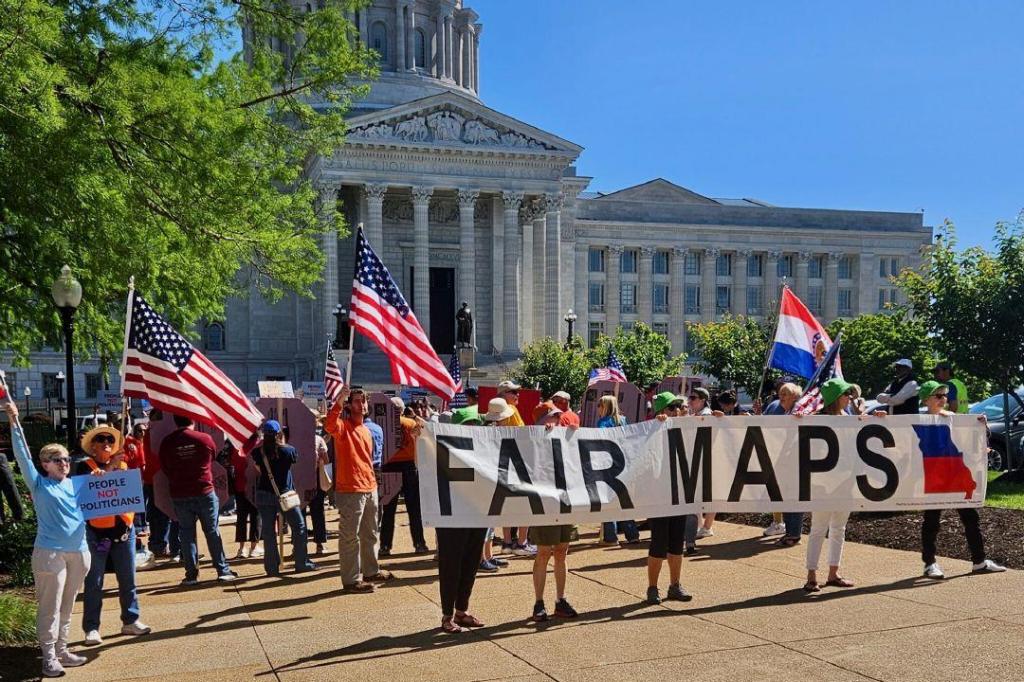
It also marks a victory for People Not Politicians, the political action committee that collected more than 300,000 signatures to force a statewide referendum on the legislature’s redistricting plan.
But whether the vote ends Missouri’s mid-decade redistricting fight remains uncertain.
Some Republican lawmakers have already suggested they could return to the issue in 2027, potentially drawing an even more aggressive map aimed at winning all eight of Missouri’s congressional seats.
For now, the vote means the boundaries used in Tuesday’s election will remain in place for the 2028 congressional races, unless the legislature passes another redistricting plan.
The defeated map would have divided Kansas City among three congressional districts, combining heavily Democratic neighborhoods with Republican-leaning communities across northern and central Missouri and the Ozarks.
The goal was to transform the 5th Congressional District, which Cleaver has represented since 2005, into a Republican stronghold.
Under the 2022 boundaries, Democratic presidential nominee Kamala Harris carried the district with roughly 61% of the vote in 2024. Trump would have won the redesigned district with about 58%.
That shift could have helped Republicans capture seven of Missouri’s eight congressional seats, despite the state’s population and congressional delegation remaining unchanged.
A national political battle
Missouri’s redistricting fight began in 2025 as Trump urged Republican-controlled states to redraw congressional districts ahead of the 2026 midterm elections.
Republicans pursued new maps in states including Texas, while Democrats sought to counter those efforts elsewhere, including California.
In Missouri, Republican lawmakers approved a new map during a September 2025 special session, arguing that the state’s congressional boundaries should better reflect its increasingly Republican electorate.
Supporters also maintained the new districts were more compact and kept more counties intact.
Opponents described the effort as a partisan gerrymander intended to dilute Democratic voting strength in Kansas City and give Republicans another congressional seat without changing voters’ political preferences.
People Not Politicians responded by organizing a petition drive to put the map before voters.
The group gathered more than 300,000 signatures, but Secretary of State Denny Hoskins refused to certify the referendum, arguing that congressional redistricting was not subject to Missouri’s constitutional referendum process.
The Missouri Supreme Court unanimously rejected that position Sept. 3, ruling that the referendum was legal, sufficient and timely.
The court also concluded the new congressional map had never legally taken effect, requiring the state to return to boundaries approved in 2022.
After weeks of conflicting federal court orders, the U.S. Supreme Court ruled Sept. 25 that the 2022 map must govern the November election.
That decision ended the immediate fight over which districts voters would use, leaving the longer-term question to Proposition A.
Money and political momentum
The final campaign was lopsided.
People Not Politicians reported at least $5.4 million in large contributions since mid-September, financing advertising and voter outreach to defeat the Republican map.
Put Missouri First, the political action committee that fought to prevent the referendum, spent roughly $2.9 million during the earlier battle but reported no large contributions after July.
Republican officials continued to endorse the map, but their organized campaign to persuade voters to approve it largely vanished.
The ballot language emphasized that the new congressional districts would keep more counties intact. It did not mention the potential partisan consequences of the proposed boundaries.
And because Proposition A was a referendum on a law already approved by the legislature, opponents of the map had to vote “no” to defeat it.
Voters ultimately rejected the redistricting plan despite Republican control of every statewide elected office and supermajorities in both chambers of the legislature.
Another map in 2027?
The vote leaves open the possibility of another confrontation over Missouri’s congressional boundaries.
Minutes after the Missouri Supreme Court blocked the 2025 map in September, Republican state Sen. Nick Schroer posted “8-0 2027” on social media, signaling interest in a new plan intended to give Republicans all eight congressional seats.
Hoskins has also said he could envision lawmakers revisiting redistricting next year.
Whether Republicans could pursue another map may depend on Amendment 6, another measure approved by voters on Tuesday’s ballot.
That constitutional amendment will prohibit lawmakers from passing legislation similar in effect to a law rejected through referendum unless 80% of both legislative chambers agree to send the proposal back to voters.
Legal experts have said the provision could make another mid-decade congressional redraw extraordinarily difficult if Amendment 6 is approved. But the amendment does not define what constitutes legislation “similar in effect,” leaving room for additional court battles.
Even without Amendment 6, the Missouri Supreme Court’s September ruling established that congressional redistricting laws can be challenged through the referendum process. That means another Republican-drawn map could face another petition drive seeking to suspend it and put the question back before voters.